
How Long Does Company Registration Take in India?
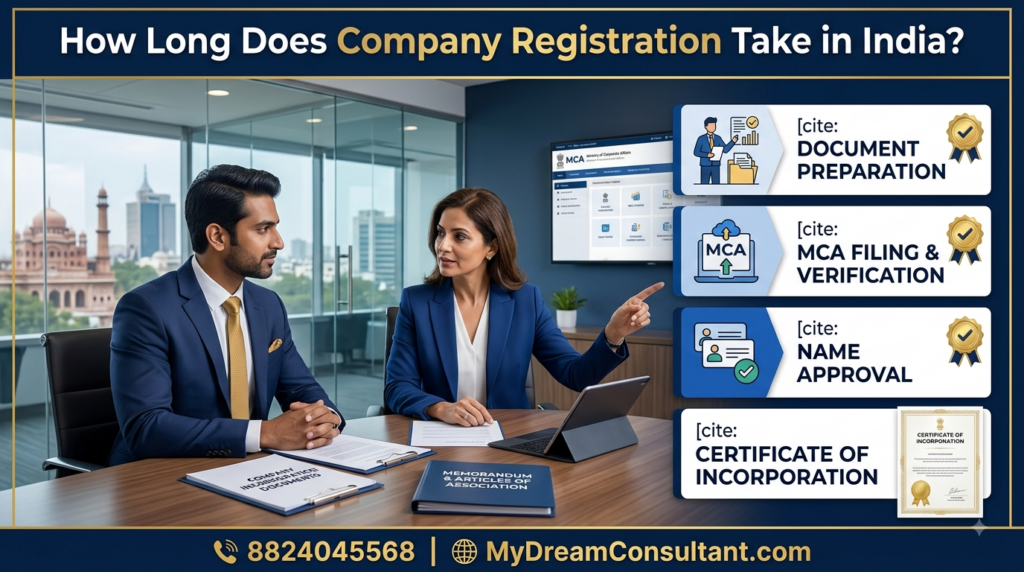
Starting a company is exciting, but one question almost every entrepreneur asks before beginning is: “How long will it take to register my company in India?” The answer is not the same for every business. The timeline depends on the type of business structure, availability of the proposed name, document readiness, MCA processing, government queries, and the complexity of the application. For many entrepreneurs, a straightforward incorporation application can be completed within a few working days after the required documents and filings are properly submitted, provided there are no objections, resubmissions, or additional approvals. However, it is better to treat this as an indicative timeline rather than a guaranteed deadline. If you are planning Company Registration in Jaipur, understanding the process beforehand can help you prepare your documents and avoid unnecessary delays. How Long Does Company Registration Usually Take? For a typical Private Limited Company, the incorporation process generally involves several stages. Stage Approximate Timeline* Document collection 1–3 working days Digital Signature Certificate (DSC) Usually 1–2 working days, subject to verification Name selection/application Depends on MCA processing and name availability Incorporation filing After documents and details are ready MCA review Generally a few working days if no clarification is required Certificate of Incorporation After successful approval *These are indicative timelines only. Actual processing time can vary depending on the application and government processing. The biggest advantage comes from being prepared before filing. Start Your Company In Just A Click —-! Click Here !—- Step-by-Step Company Registration Process Let’s understand what actually happens when you register a company. Decide Your Business Structure Before starting the registration process, decide which structure is suitable for your business. Common options include: Private Limited Company One Person Company (OPC) Limited Liability Partnership (LLP) Partnership Firm Proprietorship For startups and businesses planning to raise equity investment, a Private Limited Company is often considered. For certain professional or partner-driven businesses, an LLP may be worth considering. Choosing the structure first helps you understand the applicable documents, compliance requirements and costs. Collect the Required Documents Document preparation is one of the most important parts of the process. Depending on the structure and circumstances, documents may include: For Directors/Shareholders PAN card Identity proof Address proof Passport-size photograph Email ID Mobile number For foreign nationals or NRIs, additional documentation and compliance requirements may apply. Registered Office Documents You may need documents such as: Address proof Ownership proof or relevant property document Rent/lease agreement, where applicable Owner’s NOC, where applicable Utility bill as applicable If documents are incomplete or inconsistent, the incorporation process may take longer. Obtain Digital Signature Certificates Digital signatures are required for signing applicable electronic incorporation forms. The proposed directors/subscribers may need a Digital Signature Certificate (DSC) depending on the incorporation process. If KYC documents are properly prepared and verification is completed, this step can usually be handled relatively quickly. Choose a Company Name Choosing a suitable company name is more important than many entrepreneurs realise. The proposed name should comply with applicable naming rules and should not create conflicts with existing company names or trademarks. For example, if you want to start an IT company, simply choosing a name because it sounds attractive may not be enough. You should also consider: Existing company names Trademark conflicts Name availability Business activity Applicable naming requirements A rejected name can add time to the incorporation process. Prepare and File the Incorporation Application Once the structure, name and documents are ready, the incorporation application is prepared and submitted through the applicable MCA process. The filing may contain information relating to: Proposed company name Registered office Directors Subscribers/shareholders Share capital Business activity Constitutional documents Declarations and other required details Accuracy at this stage is extremely important. MCA Review After submission, the application is reviewed by the relevant authority. If everything is in order, the incorporation can proceed. However, the authority may raise a query or ask for clarification if something needs correction. For example: Document mismatch Incorrect information Name-related issue Incomplete address proof Incorrect attachments Other filing-related concerns If a resubmission is required, the overall timeline may increase. Certificate of Incorporation Once the application is successfully approved, the company receives its Certificate of Incorporation. This is an important milestone because it confirms the company’s incorporation. The company can then proceed with applicable post-incorporation activities and registrations. What Can Delay Company Registration? While many applications can move smoothly, several issues can increase the timeline. Incorrect Documents A mismatch between PAN, identity documents and other information can lead to problems. Name Rejection If the proposed name does not satisfy applicable requirements, another name may need to be selected. MCA Clarification If the authority raises a query, the application may require correction or resubmission. Registered Office Issues Incomplete or unsuitable address documentation can create delays. Foreign Director or Shareholder If an NRI or foreign national is involved, additional documentation and regulatory considerations may affect the timeline. Special Business Activities Certain businesses may require additional licences, approvals or regulatory permissions. Therefore, the incorporation timeline should not automatically be treated as the timeline for obtaining every business licence. Is Company Registration in Jaipur Faster? If you are searching for Company Registration in Jaipur, the core incorporation process is governed by the applicable MCA framework rather than being a separate Jaipur-only registration process. However, local professional support can be useful for: Document preparation Registered office documentation Application coordination Compliance planning Post-incorporation registrations The actual approval timeline still depends on the application and government processing. How Can You Make Registration Faster? You cannot control government processing time, but you can reduce avoidable delays. Keep Documents Ready Prepare identity, address and registered office documents before starting. Check the Name Carefully Research potential company names and consider trademark conflicts before filing. Verify Every Detail Check spelling of names, addresses, PAN details and other information. Understand Your Business Activity Clearly identify what the company will actually do. Plan Additional Registrations Depending on your business, you may also need: GST Registration MSME/Udyam Registration Trademark Registration FSSAI License Startup India recognition Other industry-specific
Difference Between Company Registration and GST Registration
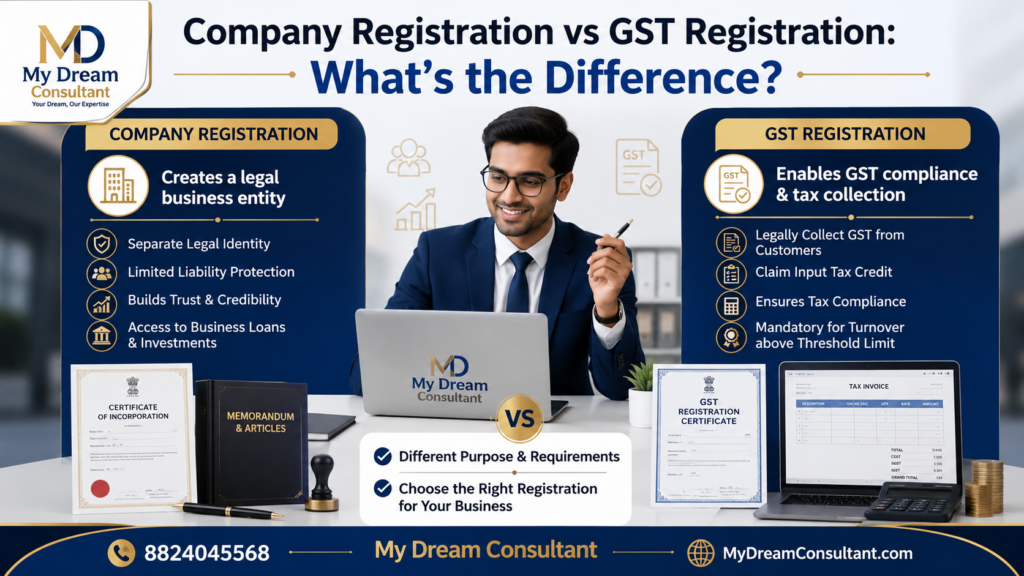
Starting a business in India involves several registrations, and two terms that often confuse new entrepreneurs are Company Registration and GST Registration. Although both are important in the right circumstances, they serve completely different purposes. In simple terms: Company Registration creates a company. GST Registration registers an eligible business under the Goods and Services Tax system. Understanding this difference can help you avoid unnecessary registrations and plan your business compliance properly. What Is Company Registration? Company Registration is the legal process of incorporating a company under the applicable provisions of the Companies Act through the Ministry of Corporate Affairs (MCA). Depending on your business requirements, you may consider structures such as: Private Limited Company One Person Company (OPC) Section 8 Company Producer Company Other applicable corporate structures After incorporation, the company receives a Certificate of Incorporation and becomes a separate legal entity. Why Register a Company? Company incorporation can provide: Separate legal identity Structured ownership Limited liability framework, subject to applicable law Better structure for certain funding arrangements Formal corporate existence Defined management and compliance framework For example, if three founders want to start a technology business and plan to bring in investors in the future, they may consider Private Limited Company Registration. Start Your Company In Just A Click —-! Click Here !—- What Is GST Registration? GST Registration is a tax registration under the Goods and Services Tax laws. It provides a business with a GSTIN (GST Identification Number) when registration is required or applicable. GST registration is generally connected with the business’s: Turnover Nature of business Type of supplies Interstate transactions E-commerce activities Other conditions under GST law Importantly, not every newly incorporated company automatically needs GST Registration simply because it has been incorporated. GST applicability must be checked based on the business’s actual circumstances and the current GST provisions. Company Registration vs GST Registration Point Company Registration GST Registration Main purpose Creates/incorporates a company Registers an eligible person/business under GST Authority/framework MCA / Companies Act framework GST law and tax authorities Result Company incorporation GSTIN Applies to Businesses choosing a company structure Businesses/persons meeting applicable GST requirements Creates separate legal entity? Yes, for a company No Main focus Business structure and legal identity Indirect tax compliance Ongoing compliance ROC and other applicable compliance GST returns and tax compliance, where applicable Is GST Registration Required for a Private Limited Company? Not necessarily in every case. A Private Limited Company may need GST Registration if it falls within the applicable GST registration requirements. For example, GST considerations may arise based on: Turnover Nature of supplies Interstate transactions Specific categories of business Other statutory conditions Therefore, a company should not assume that GST registration is automatically mandatory immediately after incorporation. Can You Get GST Registration Without Company Registration? Yes. GST Registration is not limited to companies. Depending on eligibility and circumstances, GST registration may apply to different types of businesses and taxpayers, including: Proprietorships Partnership firms LLPs Private Limited Companies OPCs Other eligible entities For example, a freelancer operating as a proprietorship may obtain GST Registration if the applicable GST requirements are satisfied. So, GST Registration does not mean that you have registered a company. Simple Example Suppose Rahul starts a software consulting business in Jaipur. He has two separate decisions: Decision 1: Business Structure Rahul decides whether to operate as: Proprietorship OPC LLP Private Limited Company This is a business structure decision. Decision 2: GST Rahul then checks whether GST registration is required based on his turnover, services, transactions and applicable GST provisions. This is a tax registration decision. These two processes should not be confused. What Happens After Company Registration? Registering a company is only the beginning. Depending on the business, you may also need to consider: GST Registration If applicable under GST law. MSME/Udyam Registration For eligible enterprises. Trademark Registration For protecting an eligible brand name or trademark. FSSAI License For businesses involved in applicable food-related activities. Startup India Recognition For eligible startups meeting the applicable criteria. ROC Annual Compliance Companies have ongoing corporate compliance requirements after incorporation. Why Is the Difference Important? Many entrepreneurs make the mistake of thinking: “If I have a company, I automatically have GST registration.” That’s not correct. Similarly: “If I have GST registration, I have registered a company.” That’s also incorrect. A business can have a GST registration without being a company, and a newly incorporated company may not necessarily require GST registration immediately. The correct approach is to identify the business structure first and then check which tax and regulatory registrations apply. Which Registration Should You Get First? There is no single sequence that applies to every business. If you’re starting a company, you would generally first determine the appropriate business structure and incorporation requirements. After that, you should evaluate applicable registrations such as GST, depending on the nature of the business and the applicable law. The exact process can vary based on your business activity and circumstances. Company Registration in Jaipur If you’re planning to start a business in Jaipur, choosing the right structure is an important first step. You may be considering: Private Limited Company Registration LLP Registration OPC Registration Company Registration in Jaipur GST Registration Startup India Registration Trademark Registration MSME Registration Instead of choosing a registration only because someone recommended it, understand why you need it and what compliance will follow. Frequently Asked Questions Is Company Registration the same as GST Registration? No. Company Registration creates a company, while GST Registration is a tax registration under GST law. Does every company need GST Registration? Not necessarily. GST applicability depends on the relevant provisions and the business’s circumstances. Can a proprietorship get GST Registration? Yes, where the applicable GST registration requirements are met. Does GST Registration create a company? No. GST registration provides a GSTIN; it does not create a separate company. Can an LLP get GST Registration? Yes, if GST registration is applicable to the LLP. Can I register a company without GST? In applicable circumstances, yes. GST registration should be evaluated separately based
Best Business Structure for Freelancers, IT Companies & Startups
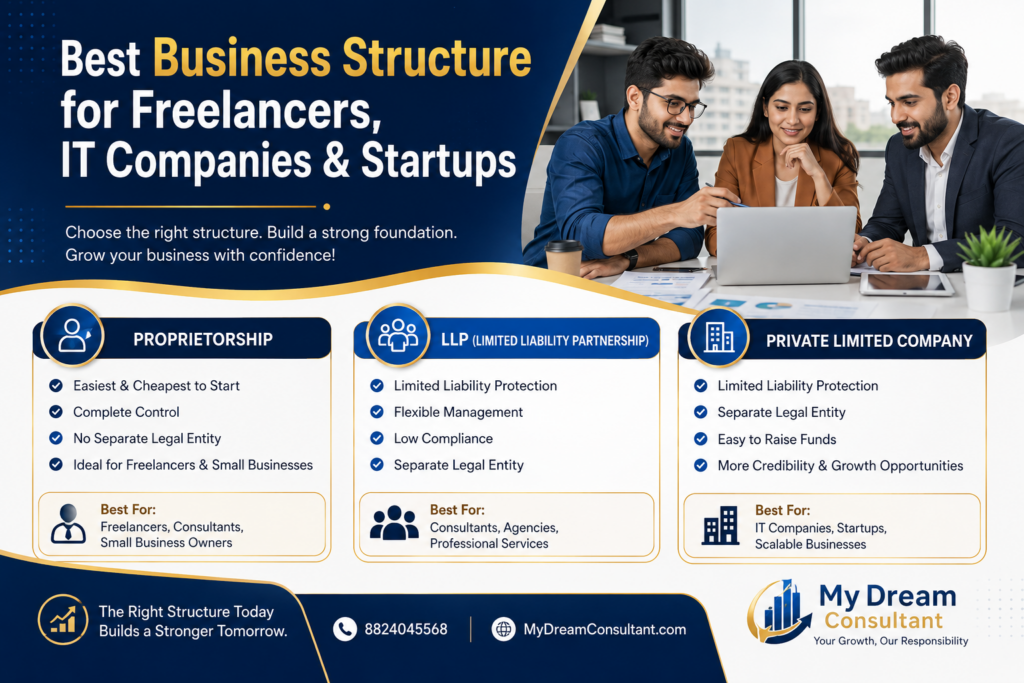
Starting a business is exciting, but one decision can have a long-term impact on your finances, compliance, liability, and growth: choosing the right business structure. A freelancer working alone may not need the same structure as a technology startup planning to raise investment. Similarly, two IT professionals starting together may find an LLP more suitable than operating as an informal partnership. So, what is the best business structure for freelancers, IT companies and startups in India? The answer depends on your number of founders, business activity, investment plans, liability concerns, taxation, compliance requirements and future growth plans. In this guide, let’s understand the major options in simple language. Why Choosing the Right Business Structure Matters Many entrepreneurs focus on getting their business started quickly and think about the structure later. This can create unnecessary complications. Your business structure can affect: Ownership and decision-making Personal liability Tax and accounting requirements Business credibility Ability to raise funds Investor participation Compliance requirements Banking and contracts Future expansion For example, a freelancer earning income from professional services may prefer a simpler structure, while a startup looking for investors may need a structure that can accommodate multiple shareholders. The right structure should match both your current business and your future plans. Main Business Structures in India For freelancers, IT companies and startups, the commonly considered structures include: Sole Proprietorship Partnership Firm Limited Liability Partnership (LLP) One Person Company (OPC) Private Limited Company Each has its own advantages and limitations. Start Your Company In Just A Click —-! Click Here !—- 1. Sole Proprietorship – Simple Option for Freelancers If you are working alone as a freelancer, consultant, designer, developer, content creator or independent professional, a sole proprietorship may be one of the simplest ways to start. There is no separate company entity in a traditional proprietorship. The business and owner are closely connected. Suitable for: Freelancers Individual consultants Independent professionals Small service providers Home-based businesses Small-scale entrepreneurs Advantages Simple setup Relatively fewer formalities Direct control over the business Suitable for small operations Limitations The proprietor generally has unlimited personal liability for business obligations. It may also be less suitable when you want to bring in equity investors or create a more formal corporate structure. Example Suppose Rahul is a freelance web developer in Jaipur. He works with several clients and does not have any partners or employees. His business is relatively small and he wants to keep administration simple. A proprietorship could be an option for him to consider. However, if Rahul plans to build a technology company and raise funding in the future, he should evaluate whether another structure would be more appropriate. 2. Partnership Firm – For Two or More People If two or more people want to start a business together, they can consider a partnership firm, subject to applicable law. It can be useful for businesses where the partners want to share: Investment Profits Responsibilities Business decisions Suitable for: Small businesses Family businesses Professional ventures Businesses with a small number of partners However, traditional partnerships generally do not provide the same limited-liability framework as an LLP. This is an important consideration when business risk is significant. 3. LLP – A Flexible Option for Professional Businesses A Limited Liability Partnership (LLP) combines elements of partnership-style management with limited liability. An LLP can be considered by businesses where two or more partners want to work together while maintaining a more formal structure. Suitable for: IT service companies Consulting firms Professional firms Agencies Small businesses with multiple founders Businesses where partners actively manage operations Key advantages Separate legal identity Limited liability, subject to applicable law Partnership-style flexibility Suitable for multiple partners Generally less complex than a private company in some respects Example Imagine two software developers and one UI/UX designer decide to start an IT services business. They want to share profits and responsibilities but don’t currently plan to raise venture capital. An LLP could be one structure they evaluate. However, if they plan to bring in multiple investors and issue equity shares, a Private Limited Company may be more suitable. 4. OPC – For a Solo Entrepreneur An One Person Company (OPC) is designed around a single member and can be considered by certain entrepreneurs who want a corporate structure while operating individually. It can be relevant for: Solo consultants Individual professionals Independent business owners Entrepreneurs who want a company structure An OPC can provide a separate legal identity and limited-liability framework, subject to applicable law. But there is an important point If your business is expected to add co-founders, shareholders or investors, you should compare OPC with a Private Limited Company before incorporation. Your business may start with one person today but look very different two or three years from now. 5. Private Limited Company – Popular for Growth-Oriented Startups For startups and businesses with ambitious growth plans, a Private Limited Company is often one of the structures considered. It can be particularly relevant when the founders want: Multiple shareholders Equity-based ownership External investment Structured management Long-term scalability Suitable for: Technology startups IT companies SaaS businesses Product companies E-commerce businesses Businesses planning external funding Growth-oriented startups Example Consider three founders developing a SaaS product. They expect to: Hire employees Acquire customers across India Raise angel investment Bring in institutional investors Expand internationally In such a situation, a Private Limited Company may be worth considering because its corporate structure can accommodate multiple shareholders and equity investment. Freelancers vs IT Companies vs Startups Here’s a simple comparison: Business Type Structure to Consider Solo freelancer Proprietorship / OPC Independent consultant Proprietorship / OPC Two-person IT venture LLP / Private Limited Professional partnership LLP Small IT service business LLP / Private Limited Technology startup Private Limited Startup seeking investors Private Limited SaaS/product startup Private Limited Solo founder with corporate structure OPC High-growth startup Private Limited This is only a starting point. The final choice should depend on the actual circumstances of the business. LLP vs Private Limited Company One of the most common questions from
Can One Person Register a Company?
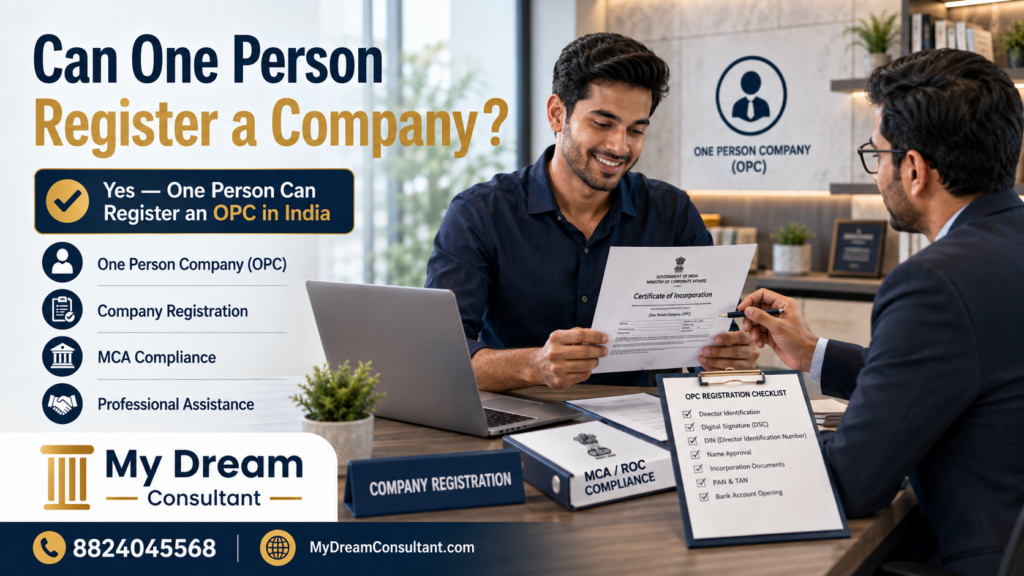
Yes. A single person can register a company in India through an OPC, subject to the applicable legal requirements. Under the Companies Act framework, an OPC is a company with only one member. MCA’s incorporation instructions specifically require nominee-related documents for an OPC, including the nominee’s consent and identity/residential proof. This makes an OPC an option for entrepreneurs who want to start and control a business individually while using a corporate structure. But there is an important question: Is OPC the right structure for your business? Not necessarily. If you expect multiple owners, outside equity investment or rapid expansion, a Private Limited Company may be worth considering instead. What Is a One Person Company? A One Person Company (OPC) is a company structure designed around a single member. Unlike a traditional partnership, there is no requirement for multiple members to own the company. An OPC can offer: Single-member ownership Separate legal identity Limited liability, subject to applicable law Formal corporate structure Business continuity through the nominee mechanism The OPC incorporation process includes specific nominee requirements. MCA’s SPICe+ instructions state that consent of the nominee and the nominee’s identity and residential proof are required for OPC incorporation. Who Should Consider an OPC? An OPC may be considered by: Solo entrepreneurs Freelancers building a formal business Independent consultants Professionals Small business owners Individual service providers Entrepreneurs who want a corporate structure For example, imagine Amit, a Jaipur-based digital consultant. He is currently the only owner of his business and does not want a partner. He wants a formal corporate structure and wants to separate his personal and business affairs as permitted by law. An OPC could be one structure for him to evaluate. Start Your Company In Just A Click —-! Click Here !—- Who May Prefer a Private Limited Company? An OPC may not be ideal if your business is already planning for multiple shareholders or significant equity investment. A Private Limited Company may be more appropriate when you plan to: Add multiple shareholders Raise equity investment Bring in co-founders Build a larger management structure Scale the business significantly Therefore, don’t select an OPC simply because you are currently the only founder. Think about where your business could be three to five years from now. OPC vs Private Limited Company Feature OPC Private Limited Company Members Single member Multiple members Separate legal identity Yes Yes Limited liability Generally available, subject to law Generally available, subject to law Suitable for solo founder Yes Can be structured with more than one member Multiple shareholders Not as an OPC Yes Equity funding More limited Generally more suitable Corporate compliance Applicable Applicable Best suited for Certain solo entrepreneurs Growing businesses/startups The “better” structure depends on the entrepreneur’s business model and long-term plans. OPC Registration Process in India The incorporation process is generally completed through the MCA’s online incorporation system. Step 1: Decide the Business Structure First, determine whether OPC is actually suitable for your business. Step 2: Select a Company Name Choose a name that complies with applicable naming requirements and does not conflict with existing company or trademark considerations. MCA’s name rules contain provisions regarding names that are too similar to existing companies. Step 3: Obtain Digital Signature The proposed subscriber/director generally needs the required digital signing facility for electronic incorporation filings. Step 4: Prepare Documents Prepare identity, address, registered-office and nominee-related documents. Step 5: File Incorporation Forms The incorporation application is submitted through the applicable MCA electronic filing process. Step 6: MCA Review MCA examines the application and may raise a resubmission requirement if corrections or additional information are needed. Step 7: Certificate of Incorporation Once approved, the company receives its Certificate of Incorporation and related identification details. Eligibility for OPC Registration Eligibility should always be checked against the current Companies Act and applicable rules at the time of incorporation. The incorporation documentation specifically requires nominee information for an OPC. An entrepreneur should also check: Whether they satisfy the applicable member eligibility Nominee requirements Director requirements Registered-office requirements Name availability Restrictions applicable to the proposed business activity Because rules can change, professional verification is advisable before filing. Documents Required for OPC Registration Common documents may include: For the Proposed Member/Director PAN Identity proof Address proof Photograph Mobile number Email address For Registered Office Depending on the situation: Address proof Utility bill Rent/lease agreement, where applicable Owner’s NOC, where applicable For Nominee MCA incorporation instructions specifically provide for: Nominee consent Nominee identity proof Nominee residential address proof The exact documentation can vary depending on the applicant’s circumstances. How Much Does OPC Registration Cost? There is no single fixed cost that applies to every OPC registration. The total cost may depend on: Government filing fees Stamp duty Authorized capital State-specific charges Digital signature requirements Professional fees Additional services required Professional fees also vary between service providers and according to the complexity of the incorporation. For an accurate quotation, the proposed business structure and documentation should be reviewed first. How Long Does OPC Registration Take? There is no guaranteed fixed timeline. The actual time can depend on: Document readiness Name approval MCA processing Resubmission requirements Government processing time Complexity of the application A properly prepared application can help reduce avoidable delays. Benefits of One Person Company 1. Single Ownership The business can be owned by one member. 2. Corporate Identity The business operates through a registered company structure. 3. Limited Liability Structure The member generally receives limited liability protection, subject to the applicable law and circumstances. 4. Professional Image A registered corporate structure may help create a formal image with clients, vendors and financial institutions. 5. Business Continuity The nominee mechanism provides a framework for continuity in specified circumstances. What About GST Registration? OPC registration and GST Registration are separate matters. GST registration depends on factors such as: Business activity Turnover Place of supply Applicable GST provisions Therefore, registering an OPC does not automatically mean that GST registration is mandatory in every situation. What About Startup India Registration? An OPC may explore Startup India Recognition
ROC Compliance After Company Registration – What Every Director Must Know
Registering a company is only the beginning of your business journey. Once a company is incorporated, its directors also take responsibility for keeping the company compliant with applicable corporate laws. Many new business owners focus on registration but overlook what comes next. ROC compliance, accounting records, annual filings, board meetings, statutory registers, tax filings and other applicable compliances need regular attention. This guide explains the basics in simple language so that directors can understand what they should track after company registration. SEO Information SEO Title: ROC Compliance After Company Registration: Guide Meta Title: ROC Compliance After Company Registration | Director Guide Meta Description: Learn ROC compliance after company registration, including annual filings, documents, timelines, director duties and practical tips for Indian companies. URL Slug: roc-compliance-after-company-registration Focus Keyword: ROC Compliance After Company Registration Secondary Keywords ROC Annual Compliance MCA Compliance Company Compliance ROC Filing Annual ROC Filing Private Limited Company Compliance MCA Annual Filing Company Annual Return AOC-4 Filing MGT-7 Filing MGT-7A Filing DIR-3 KYC Company Compliance Services ROC Compliance Jaipur Long-Tail Keywords ROC compliance after company registration ROC annual compliance for private limited company annual compliance requirements for private limited company what compliance is required after company registration ROC filing requirements for newly incorporated company company annual compliance in India ROC Compliance After Company Registration – What Every Director Must Know Introduction Getting a Certificate of Incorporation can feel like the finish line. In reality, it is the beginning of your company’s compliance journey. After incorporation, directors need to ensure that the company maintains proper books and records, completes applicable statutory filings, follows meeting requirements and keeps its information updated with the Ministry of Corporate Affairs (MCA). The exact requirements depend on the company’s type, size, activities and applicable exemptions. Therefore, directors should not assume that every company has exactly the same compliance checklist. If you have recently completed Private Limited Company Registration, understanding your ongoing obligations can help you avoid missed filings and unnecessary compliance problems. Why ROC Compliance Matters ROC compliance is important because a registered company is expected to continue meeting its legal and reporting obligations after incorporation. Regular compliance helps you: Keep the company’s MCA records updated Maintain proper corporate records Avoid unnecessary additional fees and penalties Support smooth banking and financial processes Maintain credibility with investors and business partners Keep directors informed about the company’s statutory position Make future changes, funding or restructuring easier The Companies Act requires companies to maintain books of account and relevant records. Start Your Company In Just A Click —-! Click Here !—- What Is ROC Compliance? ROC compliance refers broadly to filings, records, returns and other statutory requirements that a company must complete with the Registrar of Companies (ROC) under the Companies Act and applicable rules. Some requirements are annual, while others arise because of specific events or transactions. For example, a company may have to deal with: Annual financial statement filing Annual return filing Director-related filings Auditor-related filings Registered office changes Changes in directors Changes in share capital Charges created with lenders Certain resolutions and agreements Other event-based MCA filings The applicable forms and requirements can change, so the current MCA requirements should always be checked before filing. Important ROC Compliance Requirements Maintain Proper Books of Account A company must maintain proper books of account and relevant records as required under the Companies Act. These records help directors understand the company’s financial position and also form the foundation for financial statements and statutory reporting. The Companies Act specifically requires companies to maintain books of account and relevant papers and provides for their preservation. Prepare Financial Statements At the end of the financial year, the company needs to prepare its financial statements in accordance with applicable requirements. Depending on the company, these may include: Balance Sheet Statement of Profit and Loss Cash Flow Statement, where applicable Notes to accounts Other required statements The financial statements must comply with applicable accounting and legal requirements. File Financial Statements with ROC Companies generally file their financial statements with the ROC through the applicable MCA form, such as AOC-4 or another applicable version/form. The MCA identifies AOC-4 as the form for filing financial statements and related documents with the Registrar. The exact form depends on the company’s circumstances. File the Annual Return Companies are also required to file their annual return in the applicable form. Depending on the company’s classification, this may include MGT-7 or MGT-7A, as applicable. Annual return information can include details relating to the company’s registered office, shareholding, directors, members and other prescribed information. Complete Director-Related Compliance Directors should keep their MCA records updated. For example, DIR-3 KYC requirements may apply to directors and should be monitored according to the applicable rules and MCA requirements. Directors should also ensure that changes in directorship or other prescribed particulars are reported within the applicable time. What About the First Year of a New Company? A newly incorporated company should not assume that it has no compliance obligations simply because it has not started generating revenue. Depending on the incorporation date and circumstances, the company may still need to: Maintain accounting records Complete applicable auditor-related requirements Hold required meetings Maintain statutory registers Prepare financial statements Complete applicable annual filings Meet tax and other regulatory requirements No business activity does not automatically mean no compliance. This is one of the most common misunderstandings among first-time entrepreneurs. ROC Compliance Calendar – What Directors Should Track Compliance Area Typical Nature Books of Account Ongoing Board Meetings As applicable Statutory Registers Ongoing Financial Statements Annual ROC Financial Statement Filing Annual Annual Return Annual Director KYC As applicable Auditor-related filings As applicable Change in Directors Event-based Change in Registered Office Event-based Share Capital Changes Event-based Charge-related filings Event-based Important: The exact due dates and applicability depend on the company and the relevant provisions. Directors should verify the current MCA requirements rather than relying on a generic calendar. ROC Compliance vs GST Compliance These two are often confused. ROC/MCA compliance primarily relates to the company’s corporate and statutory
Private Limited Company vs LLP vs OPC vs Partnership – Which One Should You Choose?

Starting a business is an exciting journey, but before you begin, you need to answer one important question: Which business structure is right for you? Many entrepreneurs are confused about whether they should register a Private Limited Company, LLP (Limited Liability Partnership), One Person Company (OPC), or Partnership Firm. Each business structure has different legal requirements, tax implications, compliance responsibilities, and growth opportunities. In this guide, we’ll help you understand the key differences so you can make an informed decision. Why Choosing the Right Business Structure Matters Your business structure affects: Legal liability Taxation Investment opportunities Annual compliance Business credibility Future expansion Choosing the wrong structure today may lead to unnecessary costs and compliance issues later. Private Limited Company A Private Limited Company is one of the most preferred business structures for startups and growing businesses. Best For: Technology startups Manufacturing businesses E-commerce companies Businesses planning to raise investment Advantages Limited liability protection Separate legal identity Better credibility Easy to attract investors Business continuity Limitations Higher compliance requirements Annual ROC filings are mandatory Start Your Company In Just A Click —-! Click Here !—- Limited Liability Partnership (LLP) An LLP combines the flexibility of a partnership with the benefit of limited liability. Best For: Professionals Consultants Service providers Small and medium businesses Advantages Limited liability Fewer compliance requirements Easy management Cost-effective Limitations Difficult to raise equity investment Less preferred by venture capital investors One Person Company (OPC) An OPC is designed for solo entrepreneurs who want the benefits of a company without having multiple shareholders. Best For: Freelancers Individual entrepreneurs Small startups Advantages Single owner Limited liability Separate legal identity Professional image Limitations Suitable mainly for single promoters Compliance requirements similar to a company Partnership Firm A Partnership Firm is one of the oldest and simplest forms of business in India. Best For: Family businesses Local trading businesses Small enterprises Advantages Easy to start Low registration cost Simple management Limitations Unlimited liability Limited funding opportunities Lower business credibility Quick Comparison Feature Pvt Ltd LLP OPC Partnership Separate Legal Entity ✔ ✔ ✔ ✘ Limited Liability ✔ ✔ ✔ ✘ Investors Preferred ✔ Limited Limited ✘ Compliance High Medium Medium Low Best For Startups Professionals Solo Founder Small Business How to Choose the Right Business Structure Choose a Private Limited Company if you want to scale your business and attract investors. Choose an LLP if you’re running a consultancy, professional practice, or service-based business. Choose an OPC if you’re starting alone and want limited liability. Choose a Partnership Firm if you are running a small family or local business with minimal compliance needs. Common Mistakes to Avoid Choosing a structure only because it’s cheaper. Ignoring future funding plans. Not considering annual compliance costs. Registering without professional advice. Delaying GST or other mandatory registrations. Real-Life Example Rahul and Priya planned to start a software company in Jaipur. Initially, they considered registering a Partnership Firm because it was simple and affordable. After consulting professionals, they realized they wanted to seek investor funding in the future. They chose a Private Limited Company, which helped them build credibility with clients and investors while supporting their long-term growth plans. This example shows why selecting the right business structure at the beginning can save time, money, and future complications. Frequently Asked Questions Which is better: LLP or Private Limited Company? A Private Limited Company is generally better for businesses planning to raise investment, while an LLP is suitable for professional and service-based businesses. Can one person register a company? Yes. A One Person Company (OPC) allows a single entrepreneur to register a company. Which business structure has the least compliance? A Partnership Firm generally has the lowest compliance requirements. Is GST registration compulsory? GST registration depends on your turnover and business activities. It is not mandatory in every case. Can I convert an LLP into a Private Limited Company later? Yes, subject to the applicable legal provisions and procedures. Conclusion There is no single business structure that suits every entrepreneur. The right choice depends on your business goals, investment plans, ownership structure, compliance preferences, and future expansion strategy. If you’re unsure which option is best for your business, it’s always wise to seek professional advice before registering your entity. Need Help with Company Registration? At My Dream Consultant, we provide end-to-end assistance for: Company Registration in Jaipur Private Limited Company Registration LLP Registration OPC Registration Partnership Firm Registration Startup India Registration GST Registration Trademark Registration ROC Annual Compliance FSSAI License MSME Registration Our team helps you choose the right business structure and complete the registration process smoothly so you can focus on growing your business. Contact My Dream Consultant today and take the first step toward building your business with confidence.
Company Registration in India (2026): Complete Step-by-Step Guide for Beginners
Starting a business is an exciting milestone, but before you begin operations, it’s important to register your business under the appropriate legal structure. Company registration not only gives your business legal recognition but also builds trust among customers, banks, investors, and government authorities. Whether you’re launching a startup, opening a trading business, or planning a manufacturing unit, this guide will help you understand the company registration process in India. What is Company Registration? Company registration is the legal process of incorporating a business under the Ministry of Corporate Affairs (MCA). Once registered, your business receives a Certificate of Incorporation, Corporate Identity Number (CIN), PAN, and TAN, allowing it to operate legally in India. Depending on your business needs, you can register as: Private Limited Company Limited Liability Partnership (LLP) One Person Company (OPC) Partnership Firm Section 8 Company Producer Company Choosing the right business structure is the first step toward long-term success. Start Your Company In Just A Click —-! Click Here !—- Why Should You Register Your Company? Registering your business offers several benefits: Legal identity for your business Limited liability protection Increased credibility with customers Easier access to business loans and funding Eligibility for government schemes and Startup India benefits Better opportunities for business expansion Step-by-Step Company Registration Process The registration process generally includes: Step 1: Choose Your Business Structure Select whether you want a Private Limited Company, LLP, OPC, or another suitable structure. Step 2: Reserve the Company Name Choose a unique business name and apply for approval through the MCA portal. Step 3: Obtain Digital Signature Certificate (DSC) Directors must obtain a Digital Signature Certificate for online filing. Step 4: Apply for Director Identification Number (DIN) Every proposed director must have a valid DIN. Step 5: Submit Incorporation Documents File the required incorporation forms along with identity proof, address proof, and registered office details. Step 6: Receive Certificate of Incorporation After approval, MCA issues the Certificate of Incorporation, PAN, and TAN. Step 7: Complete Post-Registration Formalities Depending on your business, apply for GST Registration, MSME Registration, FSSAI License, Trademark Registration, or Startup India Registration. Documents Required Typically, you’ll need: PAN Card Aadhaar Card Passport-size photographs Address proof Email ID & mobile number Registered office proof Electricity bill or rent agreement (if applicable) How Much Does Company Registration Cost? The cost depends on factors such as: Business structure Government filing fees Number of directors or partners Authorized capital Professional fees Professional charges vary depending on the complexity of the registration. How Long Does It Take? If all documents are in order, company registration generally takes 5 to 10 working days, subject to government approvals. Common Mistakes to Avoid Many first-time entrepreneurs make these mistakes: Choosing the wrong business structure Selecting a name similar to an existing company Submitting incomplete documents Ignoring future compliance requirements Delaying GST or other mandatory registrations Planning properly can save both time and money. Real-Life Example A group of friends in Jaipur planned to start an IT services company. Initially, they considered a Partnership Firm because it seemed simpler. However, after understanding their future plans to raise investment and expand nationwide, they chose a Private Limited Company. This decision helped them build greater credibility with clients and prepare for future growth. Frequently Asked Questions Which company structure is best for a startup? A Private Limited Company is often preferred by startups seeking investment and long-term growth. Can one person register a company? Yes. A One Person Company (OPC) is designed for solo entrepreneurs. Is GST registration mandatory? GST registration depends on your turnover and business activities. Can I register a company from Jaipur? Yes. Company registration is completed online and businesses in Jaipur can register through authorized professionals. What happens after company registration? You may need GST Registration, MSME Registration, ROC Annual Compliance, Income Tax filings, and other applicable registrations based on your business. Key Takeaways Registering your company provides legal recognition and credibility. Choose the right business structure based on your goals. Prepare all required documents in advance. Understand post-registration compliance obligations. Seek professional guidance to avoid costly mistakes. Conclusion Company registration is more than just a legal requirement—it’s the foundation of a successful business. The right business structure can help protect your assets, improve your credibility, and support long-term growth. Whether you’re a startup founder, freelancer, consultant, or established entrepreneur, taking the time to register your business correctly is an investment in your future. Need Help with Company Registration? My Dream Consultant offers end-to-end support for: Company Registration in Jaipur Private Limited Company Registration LLP Registration Startup India Registration GST Registration Trademark Registration ROC Annual Compliance FSSAI License Producer Company Registration Section 8 Company Registration Our experienced professionals guide you through every stage of the registration process—from choosing the right business structure to completing all legal formalities. Contact My Dream Consultant today and start your business journey with confidence. #CompanyRegistration#CompanyRegistrationIndia#CompanyRegistrationJaipur#BusinessRegistration#CompanyIncorporation#PrivateLimitedCompany #JaipurBusiness#StartupJaipur#CAInJaipur #MyDreamConsultant
Revised Return vs Updated Return (ITR-U) – What’s the Difference?
Introduction Have you ever realized after filing your Income Tax Return (ITR) that you forgot to mention an income, claimed the wrong deduction, or even missed filing the return altogether? If yes, don’t panic. The Income Tax Department provides two different options to correct such situations: Revised Return Updated Return (ITR-U) Many taxpayers think both are the same, but they serve completely different purposes. Choosing the wrong option can lead to penalties, notices, or rejection of your return. In this detailed guide, we’ll explain the difference between Revised Return vs Updated Return (ITR-U) in simple language, along with practical examples, eligibility, deadlines, benefits, and FAQs. Whether you’re a salaried employee, freelancer, business owner, or professional, understanding these provisions can save you from unnecessary tax issues. Understanding a Revised Return A Revised Return is filed when you have already submitted your Income Tax Return but later discover a genuine mistake. These mistakes may include: Forgot to report interest income Wrong bank account details Incorrect deduction claimed Salary entered incorrectly Missing capital gains Wrong TDS details Errors in personal information The purpose of a Revised Return is to replace the originally filed return with the corrected version. Start Your Company In Just A Click —-! Click Here !—- Example 1 Rahul, a software engineer from Jaipur, filed his ITR in July. Later, he realized that he forgot to include ₹35,000 interest earned from his Fixed Deposit. Instead of ignoring the mistake, he filed a Revised Return and corrected the income. This helped him avoid future notices from the Income Tax Department. What is Updated Return (ITR-U)? An Updated Return (ITR-U) was introduced under Section 139(8A) of the Income Tax Act. It allows taxpayers to voluntarily update their tax return even after the normal filing period has expired. This provision mainly benefits taxpayers who: Forgot to file ITR Missed reporting certain income Underreported income Want to pay additional tax voluntarily However, ITR-U cannot be used to reduce tax liability or claim extra refunds. Example 2 Priya runs an online business. She forgot to include ₹5 lakh received from freelance projects while filing her ITR. A year later, during financial planning, she realized the mistake. Instead of waiting for an Income Tax notice, she filed an Updated Return (ITR-U) and paid the additional tax along with applicable interest. This helped her remain compliant and reduced the chances of future penalties. Major Difference Between Revised Return and Updated Return Particular Revised Return Updated Return (ITR-U) Purpose Correct mistakes in filed return Update income or file missed return Applicable When Original return already filed Original or belated return may or may not be filed Can Reduce Tax? Yes No Can Increase Refund? Yes (if eligible) No Can Claim Additional Loss? Yes No Additional Tax Required No Yes Time Limit As prescribed under Income Tax Act Within prescribed period under Section 139(8A) Best For Correction of errors Voluntary disclosure of missed income When Should You File a Revised Return? A Revised Return is suitable when: Wrong income reported Wrong deduction claimed TDS mismatch Wrong bank details Missing investment details Salary calculation error Incorrect personal information Forgot to claim eligible exemption When Should You File ITR-U? ITR-U is useful when: You forgot to file your ITR. Certain income was left out. Income was underreported. You want to voluntarily pay additional tax. You wish to avoid future tax notices. Cases Where ITR-U Cannot Be Filed You cannot file an Updated Return if: It reduces your tax liability. It increases your refund. It converts tax payable into a refund. It increases carried forward losses. Search or survey proceedings have already started (subject to applicable provisions). Certain legal restrictions under the Income Tax Act apply. Real-Life Example Comparison Case 1 – Revised Return A salaried employee claimed an incorrect deduction under Section 80C. After realizing the mistake, he corrected the deduction through a Revised Return. No additional tax penalty was required. Case 2 – Updated Return (ITR-U) A doctor forgot to disclose consultation income worth ₹12 lakh. Two years later, before receiving any notice, she filed an Updated Return and paid the applicable tax and additional amount. This helped maintain tax compliance. Benefits of Filing a Revised Return Correct genuine mistakes Avoid Income Tax notices Accurate tax records Claim eligible deductions (where permitted) Peace of mind Benefits of Filing an Updated Return (ITR-U) Opportunity to voluntarily disclose missed income Reduces litigation Improves tax compliance Avoids future disputes Builds a better compliance history Common Mistakes Taxpayers Make Many taxpayers unknowingly: Ignore bank interest. Forget rental income. Miss freelance income. Claim incorrect deductions. Forget capital gains. Ignore dividend income. Delay correction until a tax notice arrives. Timely correction through the appropriate return can save both money and stress. Which One Should You Choose? Choose a Revised Return if: You have already filed your ITR. You only need to correct mistakes. No additional tax disclosure is involved. Choose Updated Return (ITR-U) if: You missed filing your return. You forgot to disclose income. You want to voluntarily pay additional tax and become compliant. How a Chartered Accountant Can Help Income tax laws can be complex, and selecting the correct type of return is crucial. A professional Chartered Accountant can: Review your tax records. Identify filing errors. Advise whether a Revised Return or ITR-U is appropriate. Calculate additional tax, interest, and applicable charges. Ensure timely and accurate compliance. Represent you in case of notices from the Income Tax Department. If you’re looking for the Top CA in Jaipur, the Best CA in Jaipur, experienced Income Tax Consultants, or professional assistance for ITR Filing in Jaipur or searching online for ITR Filing Near Me, expert guidance can help you avoid costly mistakes and ensure your return is filed correctly. Conclusion Understanding the difference between a Revised Return and an Updated Return (ITR-U) is essential for every taxpayer. A Revised Return is meant for correcting genuine mistakes in an already filed return, while an Updated Return offers a valuable opportunity to voluntarily report missed income or file
Capital Gains Tax on Property Sale Explained

Introduction Selling a property is one of the biggest financial transactions most people make in their lifetime. Whether you’re selling your home, a residential plot, commercial property, or an inherited asset, understanding Capital Gains Tax is essential before completing the sale. Many property owners assume that once the property is sold and the payment is received, the process is complete. However, the Income Tax Department also requires you to correctly calculate and report the profit earned from the sale while filing your Income Tax Return (ITR). A lack of knowledge about capital gains often leads to mistakes such as incorrect tax calculations, failure to claim eligible exemptions, ignoring TDS requirements, or filing the wrong ITR form. These mistakes may result in notices, delayed refunds, or additional tax liability. The good news is that with proper planning and professional guidance, property transactions can be managed smoothly while ensuring compliance with the Income Tax Act. If you’re searching for the Top CA in Jaipur, Best CA in Jaipur, experienced Income Tax Consultants, or expert assistance with ITR Filing in Jaipur, this guide will help you understand the basics of capital gains taxation in simple language. What is Capital Gains Tax? Capital Gains Tax is the tax that may arise on the profit earned from selling a capital asset such as property. Simply put, Capital Gain = Sale Value − Eligible Cost of Acquisition − Eligible Expenses (as per applicable tax provisions) The exact tax treatment depends on the applicable provisions of the Income Tax Act and the facts of your transaction. Start Your Company In Just A Click —-! Click Here !—- Which Properties are Covered? Capital gains provisions generally apply to the sale of: Residential House Commercial Property Plot or Land Office Space Shop Inherited Property Gifted Property (subject to applicable provisions) Different categories of property may have different tax implications. Factors That Affect Capital Gains Tax Your tax liability depends on several important factors, including: Purchase Price Sale Price Holding Period Improvement Expenses Transfer Expenses Nature of Property Applicable exemptions under the Income Tax Act Current tax provisions Every property transaction is unique, so proper computation is essential. Understanding Long-Term and Short-Term Capital Gains Property gains may be classified as either Long-Term Capital Gains (LTCG) or Short-Term Capital Gains (STCG) depending on the applicable holding-period rules under the Income Tax Act. The classification is important because the tax treatment, reporting requirements, and potential exemptions may differ. Real-Life Example 1 Rahul purchased a residential apartment several years ago and later sold it to upgrade to a larger home. Initially, he believed that tax would simply be calculated on the difference between the purchase price and sale price. After consulting a Chartered Accountant, he learned that factors such as eligible acquisition costs, documented improvement expenses, and available exemptions could affect the final tax computation. Proper guidance helped him complete the transaction with confidence. Expenses That May Influence Capital Gains Calculation Subject to the Income Tax Act and supporting documentation, certain costs may be relevant while computing capital gains, such as: Purchase Cost Registration Charges Stamp Duty Brokerage Eligible Improvement Expenses Transfer-related Expenses Maintain proper records and invoices to support your calculations. Importance of Maintaining Documents Always keep copies of: Purchase Deed Sale Deed Stamp Duty Receipts Registration Documents Improvement Bills Brokerage Receipts Bank Statements Property Tax Records TDS Certificate (where applicable) These documents are extremely useful during ITR filing or if any clarification is sought by the Income Tax Department. Real-Life Example 2 Priya sold a residential plot after carrying out boundary wall construction and other improvements. Because she had preserved invoices and payment records, her Chartered Accountant could accurately consider the eligible costs while preparing her Income Tax Return. Keeping proper documentation saved both time and unnecessary complications. Check AIS Before Filing Your ITR Before filing your Income Tax Return, review: Annual Information Statement (AIS) Taxpayer Information Summary (TIS) Form 26AS Compare these with your property documents and bank records to ensure consistency. TDS on Property Transactions Certain property transactions may attract Tax Deducted at Source (TDS) under applicable provisions of the Income Tax Act. Both buyers and sellers should verify whether TDS provisions apply to their transaction and ensure that the necessary compliance is completed. Common Mistakes Property Sellers Make Not Reporting Property Sale Some taxpayers believe that if TDS has already been deducted, no further reporting is required. Property transactions should still be reported correctly in the Income Tax Return wherever applicable. Ignoring Improvement Costs Failure to preserve eligible improvement bills may affect the capital gains computation. Poor Documentation Missing sale agreements, purchase deeds, or payment records can make tax filing more difficult. Not Reviewing AIS Always compare your records with the Annual Information Statement before filing your return. Filing the Wrong ITR Form Choosing the appropriate ITR form is equally important for accurate compliance. Real-Life Example 3 Amit inherited a family property and sold it after several years. Since inherited property involves additional considerations, he consulted a tax professional before filing his return. With expert assistance, he maintained the required documentation, completed the necessary calculations, and filed his ITR correctly. Can You Save Tax on Property Sale? The Income Tax Act provides certain exemptions and reliefs for eligible taxpayers, subject to prescribed conditions. Eligibility depends on factors such as: Nature of the property Type of investment made after the sale Time limits Applicable legal provisions Always consult a qualified Chartered Accountant before making financial decisions based on tax benefits. Tips to Reduce Errors While Filing Maintain complete property records. Preserve all invoices and receipts. Verify AIS and Form 26AS. Keep TDS details ready. Calculate capital gains carefully. File your ITR before the due date. Seek professional guidance for complex transactions. Why Professional Tax Guidance Matters Property taxation is one of the most technical areas of Income Tax compliance. Professional guidance helps you: Calculate capital gains accurately. Review property documents. Verify TDS credits. Check AIS and Form 26AS. Identify applicable exemptions. File the correct ITR form. Reduce the
LTCG & STCG – Latest Tax Rules Every Investor Must Know (2026 Guide)
Introduction Investing in shares, mutual funds, exchange-traded funds (ETFs), and other financial assets has become increasingly popular in India. While earning good returns is every investor’s goal, understanding the tax implications of these investments is equally important. One of the most confusing topics for investors is the difference between Long-Term Capital Gain (LTCG) and Short-Term Capital Gain (STCG). Many people know they have to pay tax on profits from investments, but they are often unsure about how those profits are classified, how they should be reported in the Income Tax Return (ITR), and what records they should maintain. Incorrect reporting of capital gains can result in errors in your Income Tax Return, delayed refunds, or notices from the Income Tax Department. With the Income Tax Department using advanced digital reporting systems like AIS (Annual Information Statement), TIS (Taxpayer Information Summary), and Form 26AS, it has become more important than ever to disclose investment income accurately. Whether you’re a first-time investor or an experienced trader, understanding LTCG and STCG will help you make informed investment decisions and remain tax compliant. If you’re searching for the Top CA in Jaipur, Best CA in Jaipur, expert Income Tax Consultants, or professional assistance for ITR Filing in Jaipur, this guide will help you understand the basics before filing your return. What are Capital Gains? A capital gain is the profit earned when you sell a capital asset for more than its purchase price. Capital assets may include: Listed Shares Mutual Funds Exchange Traded Funds (ETFs) Bonds Property Gold Other eligible investments If you sell an asset at a loss, it is generally referred to as a capital loss. Start Your Company In Just A Click —-! Click Here !—- What is Short-Term Capital Gain (STCG)? A Short-Term Capital Gain arises when a capital asset is sold within the holding period prescribed under the Income Tax Act for that category of asset. The exact holding period depends on the nature of the investment. Short-term gains are taxed according to the applicable provisions of the Income Tax Act. What is Long-Term Capital Gain (LTCG)? A Long-Term Capital Gain arises when an asset is sold after completing the prescribed holding period under the Income Tax Act. Long-term investments generally receive different tax treatment from short-term investments, subject to the applicable law. Why Should Investors Understand LTCG & STCG? Understanding the difference helps you: File your ITR correctly. Avoid incorrect tax calculations. Plan investments efficiently. Maintain proper tax records. Reduce the chances of Income Tax notices. Make informed financial decisions. Real-Life Example 1 Rahul purchased shares of a listed company and sold them after a relatively short holding period. He assumed that all investment profits were taxed in the same manner. After consulting a tax professional, he learned that the tax treatment depends on the holding period and the type of investment. This helped him file his Income Tax Return correctly. Investments Covered Under Capital Gains Capital gains taxation may apply to: Equity Shares Mutual Funds ETFs Bonds Debentures Property Gold Investments Other capital assets Different assets may have different holding periods and tax rules. Documents Required Before Filing Your ITR Before preparing your return, keep the following documents ready: Broker’s Capital Gains Statement Contract Notes Demat Account Statement Mutual Fund Statement AIS TIS Form 26AS Bank Statements These records help ensure accurate reporting. Importance of AIS & TIS AIS and TIS provide information about many financial transactions reported to the Income Tax Department. Before filing your ITR: Compare your broker’s reports with AIS. Verify capital gains entries. Check TDS details in Form 26AS. Reconcile all investment transactions. This helps reduce errors and improves compliance. Real-Life Example 2 Priya invested in several mutual funds through SIPs. During the financial year, she redeemed units from different schemes. Initially, she planned to report only one transaction. After checking her AIS and capital gains statement, she identified all the transactions and filed an accurate return. Common Mistakes Investors Make Not Reporting Capital Gains Many taxpayers believe that only salary income needs to be reported. Capital gains should also be disclosed in the Income Tax Return. Ignoring AIS Ignoring AIS can result in mismatches between your return and the Income Tax Department’s records. Using Incorrect Purchase Cost Always rely on authentic investment records. Forgetting Dividend Income Dividend income should also be considered wherever applicable. Filing the Wrong ITR Form Selecting the correct ITR form is equally important. Tips for Accurate Capital Gains Reporting Maintain complete investment records. Download annual capital gains statements. Keep all contract notes safely. Verify transactions with AIS and TIS. Reconcile Form 26AS. File your ITR before the due date. Consult a Chartered Accountant whenever required. Real-Life Example 3 Amit regularly invested in shares and ETFs. At the end of the financial year, he had hundreds of transactions. Instead of calculating everything manually, he downloaded his broker’s capital gains report and consulted a tax professional. This saved time and helped him file an accurate ITR. Why Professional Tax Guidance Matters Capital gains taxation can become complicated when you have: Multiple investment accounts SIP investments Frequent share trading Dividend income Different categories of capital assets Large transaction volumes An experienced tax consultant can help you: Calculate capital gains accurately. Review broker statements. Verify AIS and TIS. Choose the correct ITR form. Report all transactions properly. Claim eligible tax benefits wherever applicable. Avoid Income Tax notices. This is why many taxpayers search online for: Top CA in Jaipur Best CA in Jaipur ITR Filing in Jaipur Income Tax Consultants ITR Filing Near Me Professional assistance ensures accurate compliance while reducing filing errors. Tax Planning Tips for Investors Good tax planning starts before selling your investments. Consider these practices: Keep records updated. Review your portfolio regularly. Track every purchase and sale. Preserve contract notes. Check AIS before filing. Maintain dividend records. Consult professionals before making major financial decisions. Conclusion Understanding the difference between LTCG and STCG is essential for every investor. Correct reporting of capital gains helps you remain compliant, avoid